
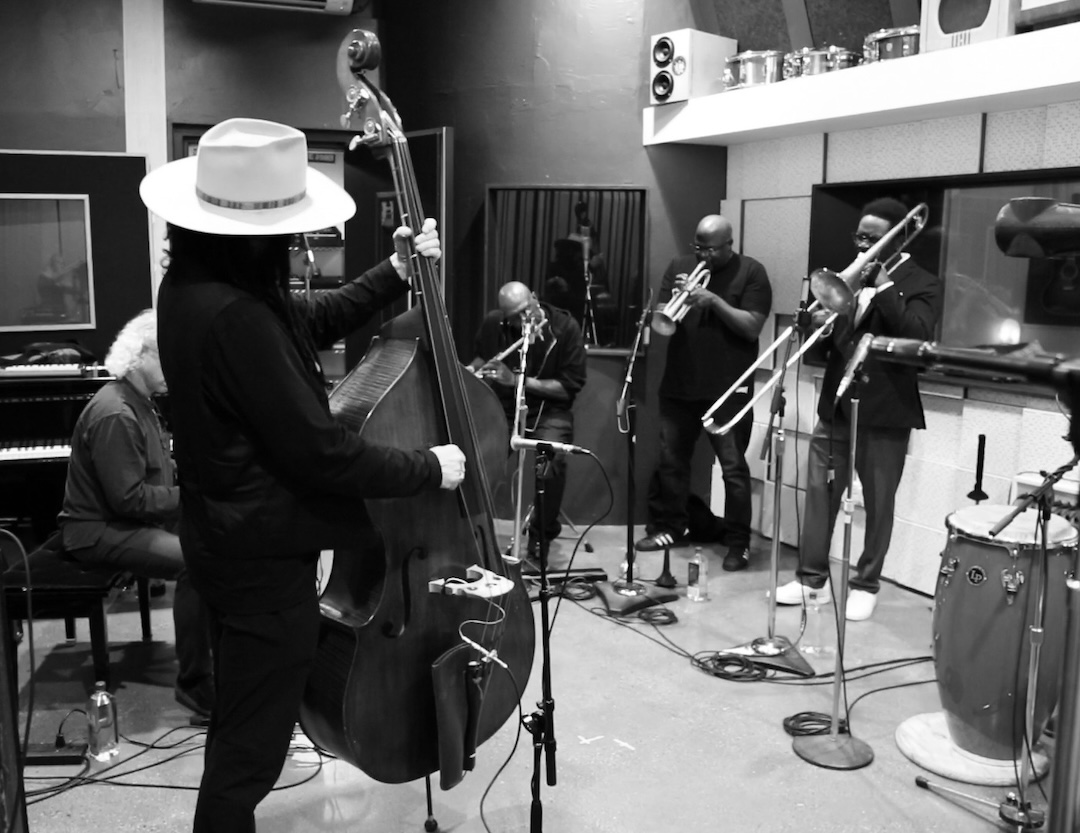
RECORDING AT RUSTBELT
Roughly half the album was cut at Rustbelt; the other half came from live tour recordings: Was says the whole thing started by accident. “We set up in that space because I like the feel of that place. It wasn’t even with the intention of rolling tape; it was just, ‘Let’s go play there.’ Then I thought, ‘Well, we’re here; let’s put up a few mics so we can listen to the rehearsal and fine-tune this.’ Al and his guys, Jake Halkey and MaKenna Gautier, just started recording. We’d go in and listen back, and it sounded like a record.”
“We miked everything in the way we would do it for a live recording,” Sutton adds. “Don’s loose, all about feel. He doesn’t care what mic or preamp you use. He listens. If he likes it, great. If not, change it. For someone like Don, you could really record it with anything and it would sound great because the band just plays so well.”
In the end, Sutton put up a mix of vintage workhorse microphones. The small room forced the team to embrace bleed, and that, Sutton says, is where the magic happened. “It goes back to old-school engineering, when a lot of people were in the room,” he explains. “If the room sounds good, the record sounds good. My room’s well-treated. It’s got just the right amount of diffusion, so when the band plays in there live, all nine of them, it sounds great—not loud or too dry.”
Nearly every channel on Groove in the Face of Adversity ran through Sutton’s H2 Audio Helios 0011 preamps, plus some vintage Calrec PQ14/15 modules and API 212s. “I like consistency across instruments,” Sutton explains. “All the drums might go through Helios, the guitars and horns through APIs and Calrecs. It keeps phase and tone coherent.”
Was laughs when asked whether gear played into his decision to record at Rustbelt. What mattered most was capturing the chemistry in the room. “I wish I could tell you there was a design behind any of this, but it was random,” he says. “I just like the feel of that space.”
For Sutton, technology exists to serve that goal. “I’ve gone through all the fads,” he says. “People chase extreme color or chase extreme clean; I think I fall in the middle.” Was echoes the sentiment. “I’d have been okay if they’d have set up one mic in the middle of the room.”
Wearing both the producer and artist hats at once was a new challenge for Was. “I probably could have used a producer,” he admits. “When I’m producing someone else, my job is to keep one foot out of the ring of fire and maintain some objectivity, because if the artist is doing their job properly, they don’t know if it’s the best thing they’ve ever done or the worst. Here, I tried to wear both hats.”
Discover more great stories—get a free Mix SmartBrief subscription!
For Sutton, it was the kind of session that reminds him why he loves the job—capturing something technology can’t replicate, the energy happening in the space itself. “A bunch of people in a room…they can work out an arrangement, do a take or two and you have a stellar performance,” he says. “This is the reason why we actually do this. It’s not to manufacture somebody’s drum track in Pro Tools.”
After five decades of elevating other artists, Was isn’t easing into legacy mode—it’s more like he’s just warming up. “This record is our handshake,” he says. “It’s us saying, ‘Nice to meet you, here’s who we are.’ I’m excited about the prospects and how this thing will evolve over the next few years.”
AudioThing updates Space Strip effect plugin to v1.3 (incl. iOS)
AudioThing has announced the release of an update to its multi-effect plugin built around simple, flexible routing. Version 1.3 of the Space Strip modular channel strip introduces iOS support alongside various improvements. The included modules Contour, Vibe, Slapback, Ambience, Ensemble, and Stereo, can be arranged in any order using drag [...]| Play | Cover | Release Label |
Track Title Track Authors |
|---|