
On December 12, Denim Tears released its first full in-house denim line following years of leaning on Levi’s as its main manufacturing partner. The first release represents a full-circle moment for the brand, which has built its universe around denim as a cultural artifact since its establishment.
Founded by Tremaine Emory in 2019, the label had only dabbled in limited drops of in-house denim until now. A beloved pair of Levi’s is how the name “Denim Tears” came to Emory, and he’s still holding onto the pair of LVC (Levi’s Vintage Clothing) jeans he bought in 2010 — a piece he wore “until they were ripped to shreds.” “Needless to say, Levi’s is great, and we look forward to working with them in the future,” Emory shared with me on a call the day before launching.
“People are often obsessed with Creative Directors, but we are nothing without the people we work with.”
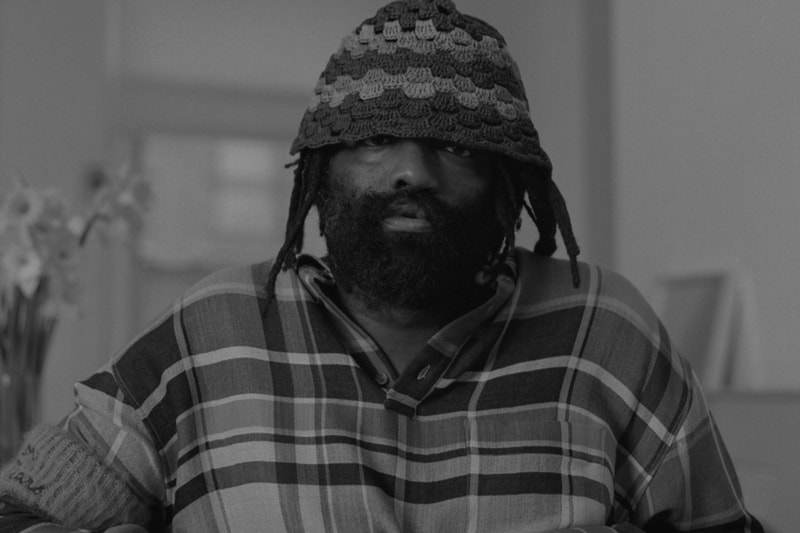
Cut, sewn, and washed in the USA, the brand debuted “Denim Tears Denim,” with a stripped-back, monochromatic campaign shot by Liam Macrae. The photos are fronted by close friends and team members, which was a conscious choice for Emory, who was quick to credit his team as he reflected on the development process.
“The brand is just as much a testament to them as it is to me,” he stated, naming colleagues Bryce, Kenji, Monique, Angel, and more. “People are often obsessed with Creative Directors, but we are nothing without the people we work with,” he added.


In two core fits (Straight and Baggy), Denim Tears offers a choice between hefty 14 oz denim and a lighter 13 oz Selvedge Denim, which is crafted in Japan using traditional shuttle looms. To complement the pants, Trucker Jackets are offered in matching fabrications, completing the look. And of course, each silhouette also comes in the brand’s signature cotton wreath print and two different washes.
Beyond aesthetics, Emory is more concerned with “the people,” both in his team and in the supply chain, ensuring that environmental and social responsibility remain top of mind. Furthermore, now having full oversight over his denim line, the creative director is determined to continue driving discourse on the fabric’s complicated legacy.
In a candid conversation, Emory expanded on the importance of acknowledging everyone involved in the process, designing denim with “emotion,” and advancing stories that have been buried in history “whether people want to hear them or not.”
You launched Denim Tears in 2019. Why did you wait until now to launch a fully in-house denim line?
Tremaine Emory: We have done seasonal in-house denim before—like the “Frog and Scorpion” collection that came out last year—but we have been working on this core program for a very long time. Needless to say, Levi’s is great, and we look forward to working with them in the future; we aren’t severing that relationship as a collaborator.
However, with Levi’s, it is a partnership where we buy a certain amount of units, so we have to work very far ahead because they are such a big company. You can’t be as nimble. This move is about having the nimbleness to change things season-to-season for our core denim program.
What is the difference between doing in-house denim this time around versus the previous seasonal releases?
Tremaine Emory: The core denim program is a broader interpretation of what denim is for the brand. Seasonal denim represents the specific story, references, and research I am doing with my team for that particular season. The core program represents the brand as a whole.

I saw that these jeans were produced in the “cleanest denim factory in the world.” Can you tell me more about the production process?
Tremaine Emory: We do our due diligence on where we make our products—how people are treated, how the clothing is made, and the quality. I have a team of about 30 people between the stores and the office, and I have people I trust who help vet these locations.
We found this factory, and it checked all our boxes. We felt we could make great denim there. We looked at the denim they’ve made and started sampling. It’s a process; it isn’t just me alone. It’s about working with my team to get it right with the right factory.

What qualities do you think make a good pair of jeans?
Tremaine Emory: Besides the quality, texture, and wash, there’s also something more existential and emotional. The jeans can’t be flat. The emotion of the jeans—and what they represent for the brand—has to be equal to the wash and the fit. That is really what we looked to achieve with this.
You are using two types of denim: a 14-ounce and a 13-ounce selvedge Japanese denim for this collection. For those not familiar, what makes selvedge construction favorable?
Tremaine Emory: It comes down to the machines it is made on. It wears better and is more durable. But again, it goes back to that emotion. There is a technical reason people feel it is better—the tightly woven fabric achieved only with certain shuttle looms—but it also gives off a specific feeling.
Regarding sourcing, are you always looking to source within the U.S., or was this specific to this collection?
Tremaine Emory: We source from all over the world. I feel some of the best factories are in China. They’ve been doing it so long, and they’re so skilled at making things. There are also great factories in Portugal, Turkey, and Japan.
However, these specific jeans are made in the USA because of the relationship we have with this factory. I’m not into regions as much as I am into the specific factory: Do they have the shuttle looms? How do they treat their employees? It’s really about the equipment and the people.

“Denim is directly connected to Black history and the diaspora, yet that story is seldom told by heritage brands.”
The leather patch on this collection is very front-and-center, featuring “1619” and the ADG flower. Can you walk me through the intention behind that design?
Tremaine Emory: It’s about viewing something seen as “Americana” and imbuing it with a history that hasn’t been recognized by the Western world. Denim jeans come from slavery. They were originally called “Negro cloth.”
Enslaved people, and later sharecroppers in the Jim Crow South, wore this cloth. Even the indigo dyeing technique comes from Africa. In my second Levi’s collection, based on the movie Daughters of the Dust, we highlighted the Gullah Geechee people, whose hands were permanently dyed blue from working the indigo.
Denim is directly connected to Black history and the diaspora, yet that story is seldom told by heritage brands. The “1619” represents the arrival of the first slave ship, the White Lion, in Virginia. Denim Tears exists to tell these stories—whether people want to hear them or not.
Do you have a favorite denim wash?
Tremaine Emory: If it has the cotton wreath, I think raw denim looks the most beautiful. For non-wreath denim, my favorite is the dark wash. That’s my preference as of today.


Do you have a “prized” pair of jeans?
Tremaine Emory: Yes. In 2010, I got a moving bonus when I worked for Marc Jacobs—the most money I’d ever had in my life at the time. I went to the Levi’s vintage store on Carnaby Street in London and bought a pair of jeans.
I wore those jeans every day for years until they were ripped to shreds. The name “Denim Tears” actually comes from those jeans, originating from an inside joke. The original fit of the jeans we make for the brand today is based on that specific pair. I still have them, even though I can’t fit into a size 36 anymore.
Finally, what are you looking forward to in 2026?
Tremaine Emory: There will definitely be more denim—both seasonal and core. But what I am really looking forward to is opening our store in Tokyo, which we are targeting for the beginning of spring.
Beyond that, I’m just looking forward to continuing to work with my amazing team. People are often obsessed with Creative Directors, but we are nothing without the people we work with. Whether it’s Bryce, Kenji, Monique, or Angel, the brand is just as much a testament to them as it is to me.
Prince may have played every instrument on the recording, but when he went on tour, he still needed The Revolution.
Click here to view full gallery at Hypebeast
The Audacity From Bali: Russell Simmons Comes Out of Hiding To Blast Kimora Lee Simmons
Getty Images / Bernard Smalls/ Kimora Lee Simmons / Russell Simmons Alleged groomer, Russell Simmons, who went into hiding to avoid facing the multiple women who accused him of sexual assault, had plenty to say about his ex, Kimora Lee Simmons. Russell Simmons got active on Threads after People began [...]| Play | Cover | Release Label |
Track Title Track Authors |
|---|