
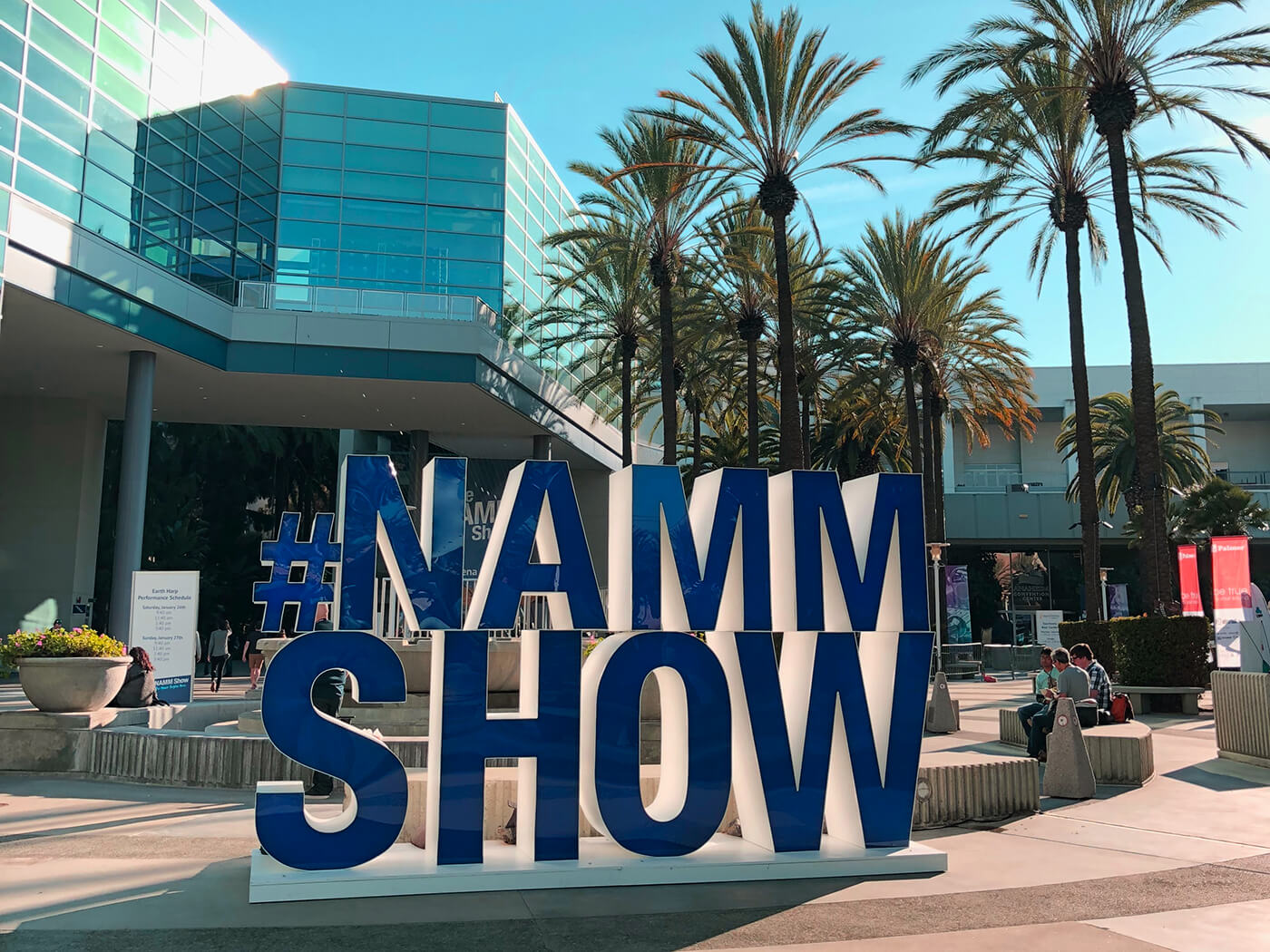
NAMM 2026 didn’t have a showstopping product. There was no behemoth booth like Universal Audio’s LUNA spectacle of 2020, and there were several major music tech brands absent from the show. Meanwhile, the boutique synth crowd has found a new home at the Buchla & Friends event in Los Angeles, which happens during the same weekend as NAMM. That sounds like a problem.
But it created an opportunity for more brands to share the spotlight with some ambitious products. From bizarre sonic sex toys and electromagnetic noise generators to acoustic synthesizers and Gameboy-style samplers, NAMM 2026 was rife with new ideas.
Here’s the gear that caught my attention throughout NAMM week.
Dog Paw
At the front of Rock Paper Scissors’ Innovator Hub (the same place where one could find the Groove Thing), a curious grid instrument was making attendees double-take.
Dog Paw is an MPE controller made by two friends, Bill and Trevor, who first teased the device at NAMM 2025, but is now presenting a more complete version. It’s a 64-pad controller designed to help you play your instruments with “no wrong notes.” You can map out the grid as a guitar fretboard, choose specific scales, and employ community-made layouts. DAW integration is tight, too.
It’s fun to play, although the pads have a different feeling than what you might expect — almost like a typewriter.
The team hit its Kickstarter target in May 2025, raising $45,892, and has since been posting regular updates about the progress of the controller. There’s still no exact word on shipping dates, but pre-orders are open now.
Casio SX-C1 Sampler

Casio’s SX-C1 sampler was being quietly flaunted at NAMM 2026, with two units on show at the side of Casio’s giant keyboard-focused booth. But the Gameboy-style sampler deserves a little bit more fanfare.
The pocket-sized SX-C1 is exactly what you think it is. It can sample sounds as 16-bit/48kHz WAV files, with a built-in mic and analogue audio input. It boasts 64GB internal storage, with a USB-C mode for transferring files between devices. It can be powered by USB-C or by four AAA batteries — although the projected battery life is a dreadful two hours.
You can play one-shots and loops on the SX-C1’s 16 pads, with up to 16 voice polyphony. Two wheels above the pads are used for trimming the start and end points of samples. The SX-C1 also has an effects bank — I was only shown the scratch effect, as it seems more effects will be added closer to release.
Casio says that the SX-C1 is still a work in progress. Many details are left as TBD, including price, so it’s unclear when this will hit the market and how different the final version might be, but we’ll definitely be keeping an eye out.

ASM Leviasynth

Arguably, the biggest synth launch at NAMM 2026 was the ASM Leviasynth. A sequel to the coveted Hydrasynth, the Leviasynth is a 16-voice hybrid synthesizer, focused around an algorithmic sound engine with eight oscillators.
The Leviasynth dragged me into its vast sound palette at NAMM for a lot longer than I planned. Its massive bank of inspiring presets, intuitive interface, and three-track sequencer had me hooked for about 30 minutes straight, building pads, sequences and squelching basslines.
A desktop version lets you perform with 16 pads, while the keyboard version has 61 keys featuring polyphonic aftertouch — both support MPE.
It’s bold, it’s brilliant, and I’m looking forward to getting a review unit to tell you more about it. If you’re already sold on the Leviasynth, you can order it now for $1,799 for the desktop version or $2,499 for the keyboard version.
Eternal Research Demon Box

MusicTech reviewed the Demon Box in late 2025, praising the unique, experimental sound but caveating that it’s chaotic and expensive. Those points are all still valid, but I have to admit, the Demon Box is cool as hell — and the Eternal Research booth was all the rage at NAMM 2026.
Complete with a stack of CRT televisions and plenty of boutique hardware synths, the Eternal Research booth was emitting a befittingly gritty vibe. Through its speakers, passers-by were treated to warped, distorted sounds from the several Demon Boxes on show, which use electromagnetic fields to generate 15 semi-random notes per second and which were controlling synths such as Black Corporation’s ISE-NIN.
The Demon Box is not an easy controller to understand. It is, however, exceptionally gnarly, and was enough to pique the interest of all types of music-makers at NAMM.
Akai MPC XL

Frustratingly, I wasn’t able to get any hands-on time with the AkaiMPC XL, since the InMusic booth was constantly packed with other attendees keen to play with it.
During the Global Media Preview day, however, we were treated to a performance from J Black, who gave us a strong idea of what the next-gen sampler is capable of.
This is the most powerful MPC ever, according to Akai, with a Gen 2 8-core processor and 16GB RAM. In practice, that means you can run 32 plugins and 16 audio tracks at once, and 256 simultaneous voices. You’ll navigate the MPC XL via a 10.1-inch multi-gesture touchscreen, and play using the expected 4×4 grid of MPCe pads.
The MPC XL’s design isn’t to everyone’s taste, however — online commenters have even said “incredibly ugly”. It’s not as slick as recent MPC models, sporting more knobs and buttons than you’ll probably know what to do with at first — but that didn’t stop NAMM attendees from giving it a go.
Korg Phase8
Korg’s acoustic synthesizer, Phase8, made a strong impression during the Global Media Preview day, with a performance that used rocks and wooden blocks to shape the synth’s sound. The synth was first teased at Superbooth 2024, but this final version seemed to have many NAMM-goers excited.
At Korg’s NAMM booth, each station with the Phase8 had a series of small objects that everyone was encouraged to use with the synth. These included stones, wooden sticks, small metallic bits, and even magnets, which added modulation beyond the different quality of sound. An AIR slider can adjust the acoustic response of the resonators.
“[Korg] wanted to do something that had never been done before,” says Rachel Aiello from KORG Berlin. “It would have been easy for them to continue making analogue synths, but they wanted to do something different.”
Fender Studio
Yes, Fender Studio Pro is PreSonus Studio One with a rebrand — and, yes, many current users are upset by the name change. But I think Fender Studio’s DAW and accompanying product line have strong potential to find new customers this year.

There was no Fender guitar booth at NAMM 2026; only the Fender Studio booth. Here, I was given a demo of Fender Studio and a first look at the new Motion controllers (which are essentially the new version of PreSonus’ Atom controllers), and the new Fender Studio Quantum interfaces.
The Motion controllers are intuitive and pack in a bunch of useful features — the brand’s representative focused on the expansive Chord mode during my demo — and are relatively affordable. Ranging from $300 to $400, both will work with any DAW but also give you a full perpetual license of Fender Studio Pro.
As for the Fender Studio Pro DAW, I’m already impressed with the layout, featureset and general workflow. It takes many cues from other major DAWs — Ableton Live, Pro Tools, etc — but also packs a ton of Fender hardware emulations.
Changing DAWs can be challenging but, as someone who primarily uses Ableton Live, I find myself quite tempted by Fender’s offering.
Stuff we can’t tell you about…
I know — this is cruel. But, at the show, a handful of brands brought us to their secret booths around the Anaheim Convention Center to share sneak previews of their big 2026 products.
I’m sworn to secrecy, so all I can say is that there are some fascinating applications of AI in upcoming music products this year, and some crazy modern iterations of classic gear. There’s really no way to be specific without breaking some NDAs, but I’d advise approaching 2026 with a curious eye.
Read more NAMM 2026 news.
The post The coolest synths, software and gear I saw at NAMM 2026 appeared first on MusicTech.
Lanvin FW26 Celebrates 100 Years of Menswear With Homme du Monde
Summary Lanvin FW26 collection marks 100 years of menswear, honoring founder Jeanne Lanvin’s 1926 tailoring debut Designs blend 1920s Venetian archival fabrics with modern, functional silhouettes A hooded sweater featuring vintage labels celebrates the house’s rich centennial history To mark the centennial of the house’s menswear division, Artistic Director Peter [...]| Play | Cover | Release Label |
Track Title Track Authors |
|---|